
[1].2604300958503.png)
The Truth Behind Georgia Power’s “Rate Freeze” & How New Data Centers Will Affect Your Bill
When people hear the phrase “rate freeze,” they naturally think one thing: my power bill won’t go up.
That’s a reasonable assumption. It’s also not quite how it works.
In Georgia, the recent decision involving Georgia Power has been widely described as a three-year rate freeze. But if you look closely at the details reported in 2025 coverage, you’ll notice something important:
Only part of your bill is actually frozen.
The part they froze — and the part they didn’t
The freeze applies only to base rates — the core charge for electricity.
But your monthly bill includes more than that. It also includes:
- Fuel costs
- Storm recovery charges
- Financing for major projects
- Various adjustments and riders
Those other pieces are not frozen. If you’re not seeing those itemized on your bill it’s because Georgia Power groups multiple line items into the Service Charge, but you can call Georgia Power’s customer service line and ask for detailed billing going forward. Then you will see something like this on your bill:
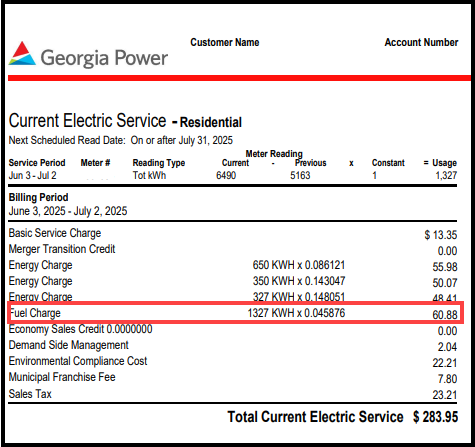
The individual line items are not small details. In fact, reporting shows Georgia Power plans to file separate cases to recover fuel costs and hundreds of millions in storm damage, which could raise bills even during the “freeze.”
So while one line on your bill stays the same, the total cost per unit can still increase.
While Georgia Power and the Public Service Commission frame the rate freeze as being something great for Georgians, the truth is the PSC has effectively handed Georgia Power a guaranteed 11.9% profit margin on its investments—a 'gold-plated' return that sits nearly 25% higher than the national average of 9.6%. As a business, locking in rates far above the market standard sounds great, especially when its customers literally cannot shop elsewhere!
Fun fact: In a staggering reversal of normal business logic, Georgia Power shareholders are actually being rewarded when they make their infrastructure costs high because they get to charge ratepayers an 11.9% profit on those costs every year. Every extra dollar spent serves as a fresh engine for their guaranteed 11.9% profit. That might explain why the Plant Vogtle nuclear Units 3 and 4 cost more than doubled its original budget.
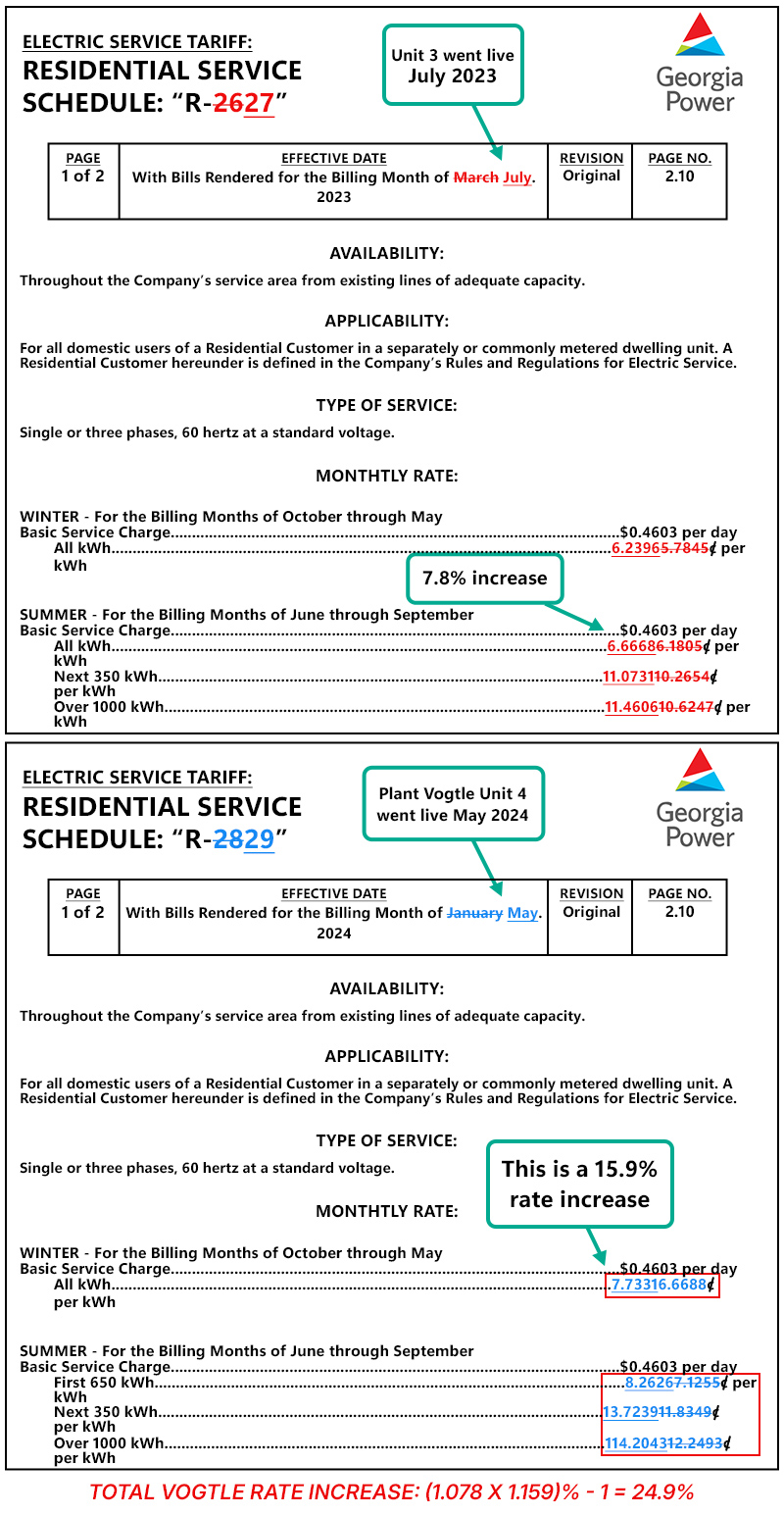
The base rate has already increased 25% since 2023
Below are Georgia Power’s rate schedules that have been redlined to show the changes:
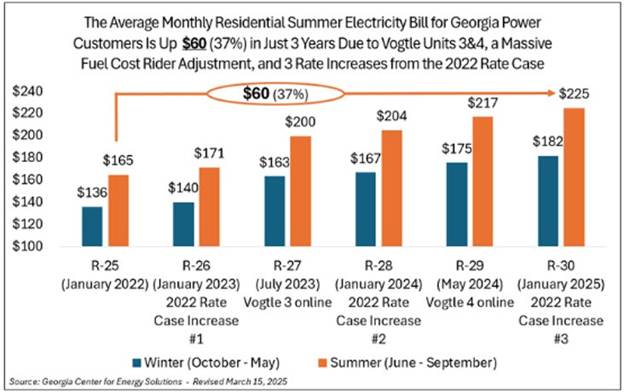
Also add increases made to the other line items and the average residential bill has gone up 37% since 2022:
A growing concern: who pays for data centers?
Another layer to this story is the rapid expansion of large data centers across Georgia. These facilities require enormous amounts of electricity, which in turn requires new power plants, new transmission lines, and long-term fuel supply.
Meeting that demand is expensive — and that investment is already underway.
Regulators at the Georgia Public Service Commission say they have rules in place to ensure that data centers pay their fair share. In theory, those safeguards are meant to prevent everyday customers from covering the cost of this expansion.
But not everyone agrees those protections are strong enough. In fact, Georgians For Affordable Energy has pointed to filings and testimony confirming that some of these costs — including new power plant construction, fuel, and financing — will still be spread across the broader customer base.
She is not alone. The Southern Environmental Law Center has issued some of the most direct warnings, describing the expansion as a potential: “$60 billion risk on the backs of everyday Georgians” and arguing that: customers’ bills are “not adequately protected.”
Why this matters for your bill
Although the rate freeze itself has already been approved, many of the decisions that actually affect your bill are still happening separately.
Fuel costs are adjusted periodically.
Storm recovery charges are approved after major events.
Large infrastructure projects are reviewed and financed over time.
Each of those are expected to increase over time and will change what you pay — even while the base rate remains frozen.
Bottom line
The phrase “rate freeze” isn’t wrong, but it is incomplete. While one part of your bill is being held steady, other costs can still rise, new expenses can still be added, and long-term investments are continuing to be built into the system. That’s why the real question isn’t whether rates are frozen — it’s whether your total bill is.
How electricity costs affect the return on solar
Retail electricity prices are one of the biggest drivers of how solar pays for itself. The more that utility rates rise over time, the more valuable each unit of energy your solar system produces becomes. Instead of relying entirely on the ever-increasing prices from Georgia Power or an Electric Membership Co-op, solar lets you lock in a predictable cost for a large portion of your energy needs.
You’ll still use the grid at times, but you’ll depend on it less — which means less of your bill is exposed to future increases. Over time, that difference adds up and improves your return.
As electricity costs go up, your savings grow – because more of your energy is coming from a source whose cost doesn’t keep increasing.
And the benefits go beyond just monthly savings. Solar can reduce your reliance on the grid, and give you more control over your energy costs long term. In a system where prices can shift in ways that are hard to predict, that kind of stability is part of the return.
Additional reading:
Georgians For Affordable Energy is operated by former PSC candidate, Patty Durand and they do a fantastic job of keeping up with Georgia Power, the PSC, and the Georgia General Assembly when it comes to energy. We highly recommend subscribing to their e-news.